
From the Head of Secondary 14.03.2020
As you are reading this I will be in Melbourne preparing for a CIS Team Meeting with peer evaluators from Australia and further afield.
For some years now I have been participating in school accreditation evaluations on behalf of the Council of International Schools. This particular school in Melbourne is at the Team Visit stage, having spent the last year working on a self-review, which is exactly what KIS is currently doing.
Visiting other schools for CIS is always a privilege. Not only is it an opportunity to support a school as it goes through the process, it’s a chance to see, in some depth and detail, how other schools ‘do things’. It’s not unknown for team visitors to go back to their own schools feeling refreshed and encouraged and carrying lots of useful ideas in their heads that they could apply to their own practice and their own schools.
The coming week will be a busy one. This is a huge school of 2200 students and the visit will be full-on every day for the week. The team will be meeting with groups of students, non-teaching staff, parents, teachers and Board members, visiting classrooms and observing lessons and writing up our observations within the accreditation protocol. My special areas are domain D: Teaching and Assessing for Learning, and Domain G: Premises and Physical Accommodation and I will be assisting with other Domains. Each evening, after the school day has finished, we will be sharing our findings and discussing whether the school has met the CIS standards for accreditation. At the end of the week our recommendation will be sent to the CIS Head Office. Today our team will meet together for the first time and talk about our initial findings [we have been scrutinizing the school self-review for 4 weeks] and tomorrow we will travel to the school to meet all the staff, have a look around the school, and settle into our school office accommodation, which will be our base for the coming week.
This experience will directly benefit KIS as undoubtedly my knowledge of the international protocol will be refreshed and developed as I see how it works in practice in another, very different, school.
While I am away the Secondary School is in the safe hands of Mr Barker, Assistant Principal, who is ably supported by Ms Service and Mr Kelly.
I am sorry to be missing Book Week, always a major event on the school calendar but I know that it will again be a huge success. If your child has not yet brought in their book for the Big Swap and the Big Read, please encourage them to do so on Monday….it’s not too late! I am sure we will be reading all about Book Week in next week’s newsletter but in the meantime take a look at Ms Colley’s insightful account of how she fell in love with books and reading, and the account of the Year 9 Geography field trip accompanied by Mrs Davis’ view of ‘A Day in the Life of….a Geography teacher’.
Mrs Margaret Renshaw
Deputy Principal and Head of Secondary
A Day in the Life of a Geography Teacher - the Trip
We are both in school early, as usual, at about 6.30am. We organise and checked the equipment we need on Tuesday after school so we know we are just about ready. Ms McNutt organises extra water bottles for our infiltration experiment. Time for some photocopying for Friday’s lessons and those next week – our cover work was prepared yesterday. Our A Level groups will be revising as they have their mock examinations next week. Mrs Davis welcomes and registers 8K from 7.40am while Ms McNutt takes the equipment down to the gate.
At 0800, we are ready to board the bus. The journey will take about 45 minutes, depending on traffic. In a welcome change from last year, the bus takes us uphill directly to the centre, thus saving us a 15 minute hike. Students collect the equipment bags from the front of the bus and we assemble for instructions and divide into three groups. Ms McNutt takes her first group up into the depths of the rainforest. Mr Baxter is testing water and so his group goes to the river which is flowing though the plantation. Mrs Davis’ group ventures part-way into the rainforest as it will be comparing rainforest with plantation.
After 15 minutes of measuring noise levels, infiltration rates and making notes on ground cover, Mrs Davis’ group marches downhill and into the plantation where it again takes measurements as before. The premise is that the rainforest should be noisier with more animals and birds and that water should take longer to infiltrate due to ground cover (not all groups found this). We also look at the prevalence of the colour green and what other colours would dominate if green was removed. Finally, students discuss the impact on fauna, the water cycle and local people if the rainforest was removed.
Ms McNutt’s group enter a living classroom. Students have four hypotheses to test and so must collect primary data in four locations for weather, light levels, amount of vegetation, noise and circumference of canopy trees. Students use thermometers, hygrometers and anemometers as well as noise meter apps. They use quadrats to measure the % cover of leaf litter at ground level. In addition, they estimate. Their aim is to establish whether there are relationships between light levels and % of vegetation in the ground level, increasing noise with greater distance into the rainforest, no difference in weather at the locations and that the taller trees will have greater circumference of trunk.
Mr Baxter leads the water testing group which aims to find out if agricultural and domestic waste water affect water composition and habitability. Students collect and test water for various chemicals such as nitrates and phosphates in two locations, upstream and down in the plantation. Students also experience the technique of kick sampling where they judge water quality by the diversity of invertebrates living in the stream sediment. Many invertebrates indicate a higher water quality.
A full range of fieldwork skills are undertaken today, giving students experience of hypothesising, collecting data in the field and analysing results. The groups do three rotations in total with breaks for snack and lunch in between. There is a lot of walking (about 8500 steps!).
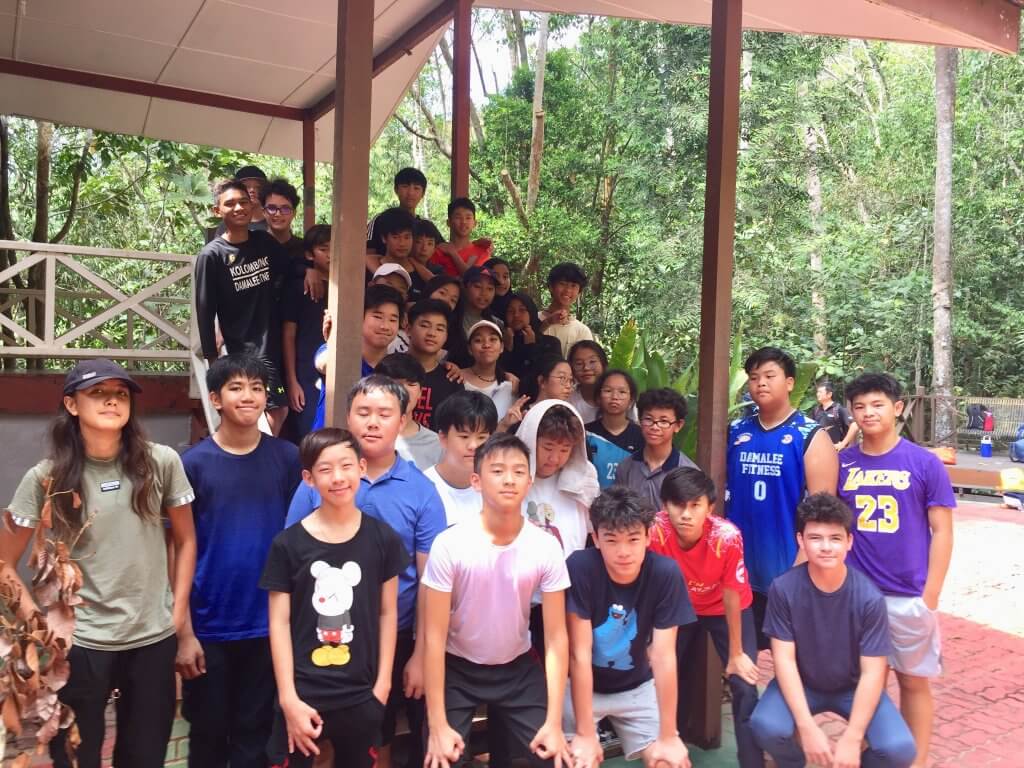
At the end, students have time for a quick dip in one of the stream’s pools, under teacher supervision of course. Equipment has to be collected and loaded onto the bus. Students change from wet or sweaty clothes and board the bus. It is a shorter journey back to school, and we are back by 3:10. Mrs Davis returns the first aid kits and gives the consent forms to the office for shredding. Mr Baxter rushes off to his basketball ECA, Mrs Davis joins the EcoWarriors for some painting and Ms McNutt is already working on her next trip, Duke of Edinburgh on Monday. We all check that there were no problems with our cover and collect any homework/tasks which will need marking that night – hopefully not too much as being out in the heat of the rainforest/plantation all day is tiring work.
Where does this field trip experience fit with High Quality Learning in Year 9? Under ‘Building skills and mindsets to thrive in the 21st Century”, Year 9 was able to develop a greater understanding of real-world issues and different perspectives. This field trip was learning in a “varied and stimulating environment” which addresses “Personalised Approaches to Learning”. Students collaborated, analysed, interpreted, evaluated, used evidence and drew cross-curricular links which encourages higher order thinking (Academic Rigour). All in all, a successful trip.
Mrs Davis
Year 9 Report on their Geography Fieldtrip to the Rainforest
I enjoyed the field trip. I took the opportunity to add some interesting knowledge about the rainforest and oil palm plantation. I’ve seen a lot of things/plants that we learnt in class. I’m also excited that that was my first time in the REAL RAINFOREST. – Adriana
It was fun and exciting, being able to enjoy nature and finding out about Mother Nature. – Alexis
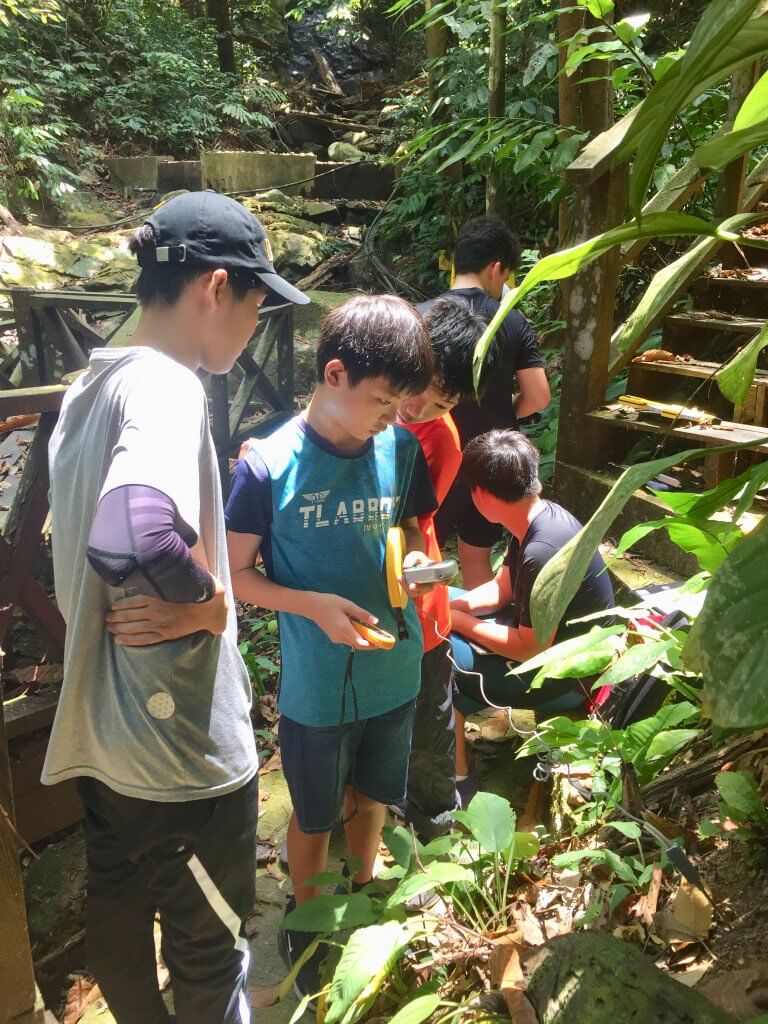
Overall, I enjoyed the trip a lot. The tests we did were such an amazing experience to go through. – Kaiyisah
It was fun to learn about new things and relaxing in the green. Also, I learnt that I have to look ahead and not step in cow dung. – Johanna
It was fun and really unique trip. We learnt a lot of things. But there were a lot of insects and I got bitten. – Ivan Chin

I got to learn about new things and enjoy the scenery. – Chloe
I really enjoyed the trip. We got to learn outside the classroom and explore new forest territory. I enjoyed all the hiking. I would totally recommend going again. – Duncan

I really enjoyed how we were able to experience what we are learning in Geography. Each activity was filled with appreciating nature. – Chan
The part I found most interesting was when Mr Eric told us which types of trees are better to plant. If you plant a tree which produces lots of leaf litter, then it will release more carbon dioxide. – Ivan Chia
I enjoy the part with Ms McNutt where we measure the light level, and the water and kick sampling with Mr Baxter. I also enjoyed learning to use the instruments. – Alan

Good way to learn by actually seeing it in real-life. – Victor
There was a lot of fun activities. – Oscar
I got to learn a lot more about the rainforest and oil palm plantation. – Clement
Lunch was nice but I wanted more. – Seo Jun
We got to experience, in reality, a lot of what we learnt in class. – Tobias

The best part was when we lost the water samples and had to go all the way down the hill to get them. – Lucas
Nice place, no leeches but had bees.
The funniest part was when we were walking on the hill and singing “Never gonna give you up”. – Annabella
I’ve learnt a lot. – MJ
The best part of the trip was at the end where we were all “skipping stones”. – Jed
It was very interesting and I learnt a lot but I needed more time; I didn’t get my booklet finished. – Lewis
“Where are all the water samples?” – Farah
I enjoyed the trip because of all the things we saw. The activities were very informative. – Tania

There is water in my wellies? – Jed
It was so tiring but I got new knowledge. – Jessy
I had fun discovering new things in the forest but going up to the forest was hard work. – Scott
We were very lucky to see, with our own eyes, many of the things that we learnt in class. – Dylan
The best part was getting soaked in the river as it was very cold and refreshing. – Keith
Overall, it was a fantastic trip. – Leya
In Homage to Reading
First loves are never easily forgotten………
I still remember mine: the weight of it in my hands, the fraying plastic around the edges, the delicacy and grace of the pictures of unicorns caught in the moonlight that so ignited my six-year-old imagination. I can still see the creases etched across the yellowing pages, trace marks left by all those readers who came before me. I even remember the size of the font, which was notably, and pleasingly, smaller than the tedious picture books that had been forced upon me up until then. It was a ‘proper’ book, a book that marked the end of the era of my parents having to bribe me with jelly beans for every page I sullenly recited to them. That book made me what I am today: a reader.
Of course, that was just the beginning. My journey through childhood, through my teenage years and finally into adulthood, is littered with literary markers that continue to shape who I am and how I see the world. From C.S. Lewis, to Bronte, to Arthur C. Clarke, to Homer and far beyond, startling vistas were revealed, and echoes of myself that I thought were peculiar to me, and me alone.
It is not just those discoveries that linger so evocatively, but the moments they were made: the reassuring thickness of Don Quixote as I huddled under the duvet while a typhoon rattled and crashed against the windows of my Korean apartment; the crispness of the paper, dried and bleached by the sun, as I turned the last page of my favourite Hemingway novel and cried on a beach over the terrible beauty and truth of his words. Those moments and memories, along with a thousand others, are among my most precious and most comforting. I am certain that my life would have been bleaker and barer without them.
Now, as an English teacher, I am duty-bound to encourage all of my students to become wide and voracious readers, a task that is more difficult with some students than with others. As I am sure many of you can attest to, every Parents’ Evening I take great pains in pointing out the correlation between good grades and healthy reading habits. This is, of course, all true and is part of the reason why we in the English Department have placed such an emphasis on regular reading sessions and broadening our students’ vocabulary this year. However, it is far from the only reason why KIS encourages our students to read as much as possible and why we even go so far as to have an entire Book Week, whereas most schools only limit themselves to a single day!
In the end, as important as IGCSEs and A levels undoubtedly are, the memories of taking those exams, of what you thought and what you felt as you feverishly wrote down your answers will fade and be forgotten. What you learn about the curious experience of being human – of being vulnerable, of being brave, of being scared, of being loved – and the way the world subtly shifts through every profound literary lesson will remain, and your life will be all the richer for it.
So, with Book Week fast approaching, I urge the sceptics, the naysayers and the techno addicts to put down their phones and to shrug off their cynicism. Instead, I ask you to devote yourself, entirely, to reading the words of others and understanding their message to the world. After all, you never know what delights, what lessons, what fantastic flights of fancy, might be waiting to entice and transport you to worlds that are far more profound than anything that lurks behind our ubiquitous phone screens.
Ms Colley
Head of English


