
From the Head of Secondary, 23.02.19
Successful Bronze Practice Adventurous Journey – Duke of Edinburgh International Award
Friday 15th saw 19 students, all participants in the Bronze level of the Duke of Edinburgh International Award, set off on their practice adventurous journey in the Kiulu valley. These students were kitted up for the first time with all the water, food, emergency kit, first aid, clothes and overnight gear that they would need for two days and one night away from home. Divided into three teams these students, accompanied by Mrs Colbeck, Mr Colbeck and Miss McNutt, put their rucksacks on at Kampong Pukak and put their best foot forward with route cards and maps in hand to navigate the river side paths and bridges from the start at Pukak towards Kiulu Town and beyond to The Adventure Centre.
Saturday 16th then saw the participants working on their teamwork, leadership and communication skills while undertaking the challenges at The Adventure Centre of either the high ropes course, abseil tower or climbing wall, followed by all ziplining across the river. Afterwards, they navigated the trail along to Tamparuli and, although almost as hot as Friday had been, the students all completed the 8km route in under 2 ½ hours.
What did the students think:
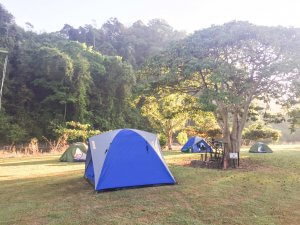
Jasmine: “The journey was challenging as it was my first AJ with the school. The temperature on the first day was intense with a scorching 38*c and on the second day it was 34*c. We had to be self sufficient. this included cooking our own food and carrying all our own food, first aid, sleeping bags and clothes for the second day. We did not have to carry our tents, as we had to carry at least 3 litres of water at all times due to the heat. The camp was clean and we had no problems setting up our tents and sleeping in them. We brought just enough food for lunch and dinner on the first day and breakfast on the second. Additional water was dropped off to us at the end legs of our route by Mr Walker in his truck. When we were walking, the hardest part was going uphill as some people were going faster than others. The downhill part was also hard as my shoes were a little worn out and I slipped once on the hot dry ground. This was a successful practice expedition and our team have been able to work out our strengths, target weaknesses and develop the navigation skills that we will need to be able to plan and then walk routes for our assessment journey in May”.


Poppy Fundraiser
We were delighted to present the MR 700 we raised, from the sale of poppies to Mr Sevee of the Kundasang Memorial Garden recently. Mr Sevee told us of his work restoring and maintaining the garden so that it is a place of reflection and contemplation, where we can remember those who died in the Second World War. We hope that this fund-raising is the beginning of a long friendship between KIS and the garden.
Under 13 FOBISIA
On Wednesday we said farewell to the KIS Vipers as they headed off to Phuket for the Pink Games. There was a distinct buzz of excitement in the air as the team gathered together for photos before boarding their flight and departing on schedule.
KIS students have attended FOBISIA games over many years and it is always a wonderful and memorable experience!
Mrs Margaret Renshaw
Assistant Principal and Head of Secondary

IGCSE and A Level Options
Over the last week both Year 11 and Year 9 students have been given their option forms for the next stage in their education.
Many Year 11 students will be choosing their A level subjects for their Sixth Form studies. We are expecting a record number of students to join our Sixth Form next year. It is a difficult time for them, as they realise that their next choices could greatly define their career choices in the future. In this time of uncertainty we hope that parents can support their students, as will we, and encourage them to make their choices wisely.
Year 9 also face a difficult choice, as for the first time they will have to choose which subjects to continue with in Year 10. IGCSE subjects are an important transition phase towards A levels and then University. Again, it is important the students choose their subjects for the right reasons, and not just because they like the teacher or their friends are doing it.
If your child is in Year 9 or Year 11 please talk to them about their choices and if you wish to discuss the choices with me please make an appointment. I am always happy to answer any questions regarding subject choices with parents and students.
Mr Ian Barker
Assistant Head of Secondary / Head of Sixth Form
The Routine of Reading:
With the recent success of Book Week here at KIS, our minds once again turn to the importance of reading. One of the most often-repeated pieces of advice given to students at school and at Parents’ Afternoon is how vitally important it is to read. As an English Teacher in Secondary, the most meaningful advice I can always provide when asked “How can I/my son/my daughter improve in English?” is to respond with:
“By reading.” Simple and essential. And relevant to not only English, but every single area of our development. Academic, social, emotional, mental health…the list of benefits to our own lives is huge. It is not so often-repeated for no reason.
This may be seen as recommendation which is losing relevance slightly in a modern world where physical books appear (for better or worse) to be fighting a battle of sorts against other means of media, but I would argue that on the contrary, there are now more opportunities for active and engaged reading than ever before. Books are just a very small (but important!) part of that.
Reading does not have to involve a book. True – It is my opinion that there truly is nothing quite as magical as sitting down with a physical book and getting lost in a story; I love it. Always have and always will. But with the emergence of instant news, room for anyone to comment on anything, and new ways to access online media, in many ways we are actually in a position now where we can find any kind of writing about anything in a matter of seconds. We can even write some of it ourselves.
Stories about any event in the world break within moments and within minutes entire articles, blogs, vlogs and so on appear for our consumption from a variety of outlets with a range of perspectives. Many of these may have explicitly conveyed opinions. Others are purely factual. Some even appear factual but have hidden agendas. All achieved through clever use of language. Surely if we read and critically develop our understanding of this, we better understand how writers work, and pick up their techniques. And then we can use them when we have to write to persuade, argue, advise or inform. And we become more critical consumers of knowledge and media. A key skill in navigating this modern, connected world.
The best way to develop vocabulary is also by reading. Studies have shown that having a routine of reading established from a very young age can bear fruit in later years, especially where vocabulary is concerned. That includes being read to by parents or guardians before reading can be done by a young person themselves. Emotion can be a complex thing to articulate. Why not equip ourselves as best as we can to be able to tell people how we feel, and to understand it more too? To interpret and describe things accurately and even creatively is a key skill which can not only assist us in our day-to-day lives, but also open so many doors for future careers. To be a good communicator is so vital in every walk of life.
Often, a recommended time to spend reading is quoted. “20 minutes per-day”. “30 minutes per-day” and so on. I disagree slightly with this way of blocking off chunks of time. In today’s world, with so many distractions, the idea of enforcing a timetable for something as liberating and enjoyable as reading feels forced. Instead, I prefer to suggest that there are a huge amount of small moments during a day when reading can be done. We are all quick to get our phones out when faced with any kind of pause in our day; they have effectively replaced boredom. The easy thing to do would be to say that is a bad thing. I actually disagree. It is a chance to read something: news, sports news, gossip columns, opinion pieces…Or a chance to get a book out, whether it be a physical paperback or even a Kindle-style book on your phone. And there you have a few minutes of reading time. A routine of reading.
In the car on the way home from school. Waiting in line at a food court. Sitting out waiting for a friend in a shopping mall. All times to read. A routine of reading.
But that should never take away from the pure and simple fact that it is good to sit as often as you can in a comfortable chair, with a good book, and just lose yourself in another world for a while. Both during good times and bad, I have often turned to lessons learnt from reading books to make decisions in my life, or to reflect on things. There are worlds and characters and stories out there which can help to guide us all, make us more critical and aware of the world around us, and fill us with emotions we never imagined a series of words on a page could make us feel. There is magic hidden between those pages.
Please value reading. It is never too late to add it to your routine. Pick up a new book or your phone today. You will not regret it.
Mr Andrew Withers
Assistant Head of Secondary


