From the Head of Secondary 19.03.2022
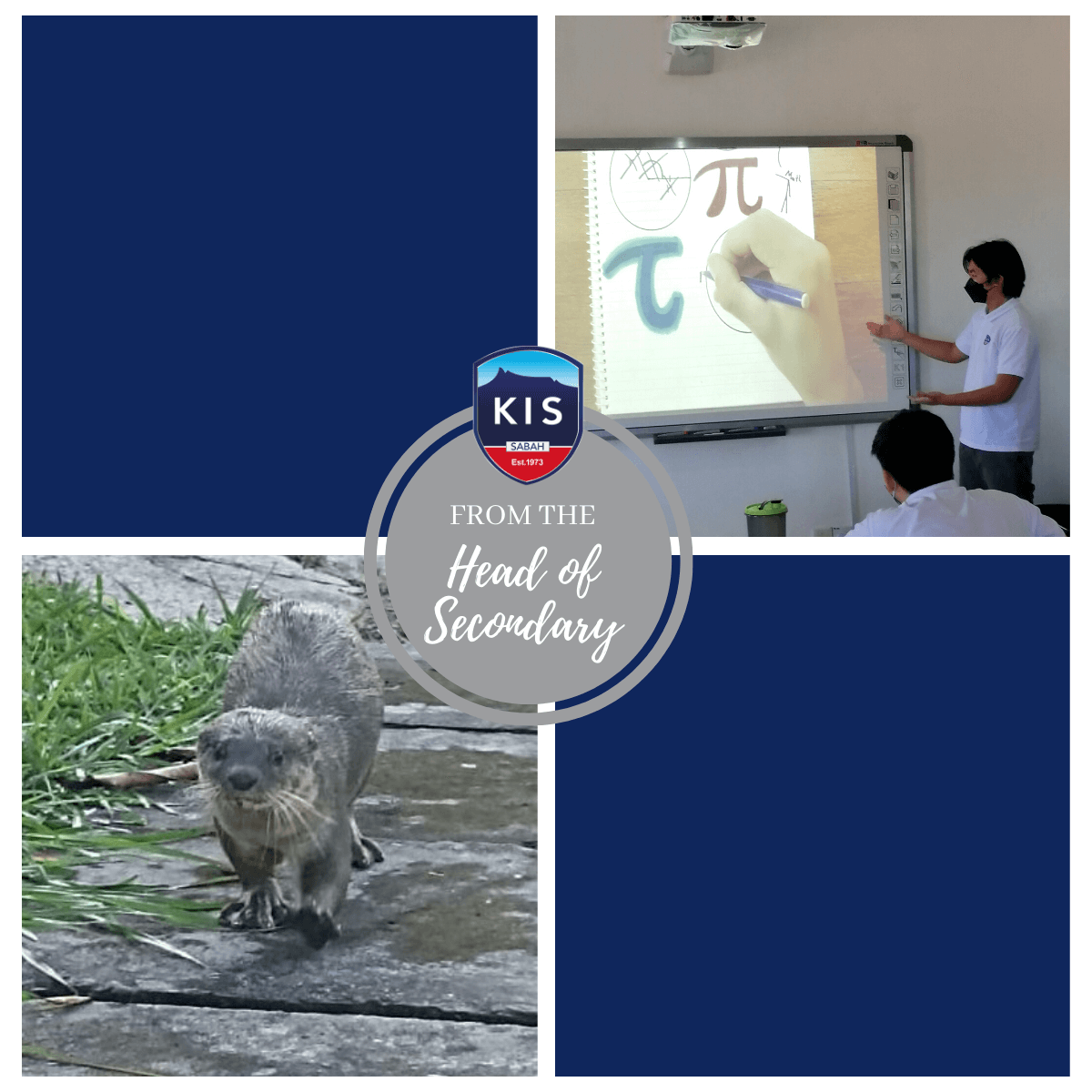
This week in Secondary we got very excited about an otter, celebrated Pi Day and thought and thought about costumes for Book Week, which is rapidly approaching. Read on to find out more about all three of these happenings.
The majority of students are back in school and working hard and things are feeling more and more ‘normal’. We are not forgetting SOPs and are taking care in every way so that we can keep everyone safe. Whilst online learning has been a tremendous boon during the last two years we always knew that it can’t replace learning in the classroom and that can be clearly seen now that we are back.
Yesterday we had our first Bake Sale in over two years. Always popular at KIS, this one was organised by the Student Council assisted by Mrs Beresford, with funds raised going to support Ukrainian refugees. The cakes were created and donated by parents and staff and were mightily enjoyed by all. Many thanks to all who supported this event.
Have a lovely weekend
Mrs Margaret Renshaw
Deputy Principal / Head of Secondary
World Pi Day(s) 2022
On Monday (14th) and Tuesday (15th) our KS3 and KS4 students celebrated World Pi Day. The “joke” here is in the timing – 3.1415 happen to be the first 5 digits of pi. Pi is an endlessly fascinating number, and days like these are designed to give our students a glimpse through a window that shows a slightly different mathematical world to the one they see most days.

Year 7 students essentially recreated mankind’s first interaction with the number pi. They answered the age-old question “How many times would the diameter of a circle fit into its circumference?” Thus they set to work, with bits of string and everyday objects that present a circular cross section, and measured diameters and circumferences. A mean (average) value of 3.08 was very creditable. Year 7 students also had great fun searching (within the first 200 million digits of pi) for familiar strings of numbers, such as birthdays and telephone numbers.
 Year 8 students had a competition to see who could draw the best freehand circle (later to be judged by Year 10 students who now know enough “Circle Theorems” to be able to check the accuracy of the drawings). Staying competitive, they then competed to see who could memorise the most digits of pi, falling quite a long way short of the world record of 70, 030. This was an important introduction to the world of irrational numbers.

Year 9 students recreated the famous Buffon’s Needle experiment. Simply by dropping toothpicks onto a plane covered with parallel lines, and counting the toothpicks that “crossed” any line, students were able, in a very short period of time, to come up with a remarkably good approximation to pi.
 This represents students’ first encounter with the fact that pi is an important number that doesn’t actually need circles to make its presence felt. Talking of approximations, Year 9 students went on to use their recent percentages skills to calculate the percentage errors involved with using well-known approximations to pi (mums and dads might just recall using 22/7 or 355/113 before being allowed to use calculators, or am I showing my age?)
Year 10 students took the idea of approximations a bit further, and essentially investigated how modern computers calculate pi to a given number of decimal places (world record currently over 62 trillion digits). This is done by working with infinite converging series, and Year 10 students compared different series to see how quickly they converged (to a given number of decimal places).

Year 11 students rarely pass up the opportunity to revise, so they found a way of engaging with pi that helped their exam preparation. They looked at co-prime numbers. Two numbers are co-prime if the only factor they have in common is 1. So Year 11 students randomly chose bigger and bigger sets of number pairs and calculated the percentage abundance of those that were co-prime. They then used the rather neat fact that the probability that a randomly chosen pair of numbers is co-prime is approximately 6 divided by pi squared. Year 11 students also looked at the debate as to whether we should use pi or, as some mathematicians would have it, tau (2pi) in our calculations.
There is a good chance that many of our students will go on to study mathematics or a mathematics-rich subject at college level and beyond. They will learn that the ways we have interacted with pi this week actually have a deep connection to algebraic structures that, not to put too fine a point on it, explain how the mathematical universe works. And to think it all started with a piece of string …
Mr Davis
Head of Mathematics
The Day Oswald the Otter Came to KIS
There was great excitement in school on Wednesday morning at drop-off time when we had an unexpected visitor, somebody that I don’t think we had ever met before…..an OTTER! Mums, dads, drivers, students of all ages, staff…… everybody was keen to catch a glimpse of this character and he [she?] made it quite easy for us…..walking and running up and down and across the road [sometimes dangerously close to oncoming traffic] and even nonchalantly coming inside onto the basketball court. We were all concerned for its safety and so eventually it was captured and crated and carted away to a safe place where it was released. I didn’t get close enough to ask him / her what his / her name was so he’s an Oswald [or an Olive]!
This was more probably a smooth-coated otter (Lutrogale perspicillata). In Sabah, we can find four species of otters: hairy-nosed otter (rare), Eurasian otter (rare), small-clawed otter (common), and smooth-coated (common). The smooth-coated otters like to live in the lower reaches of rivers and in the river mouths, but they are found in lakes and paddy fields too. They normally feed on fish, which are hunted by the whole group (family) working together. This species can be about 1 to 1.3 m in length and weigh about 5-8 kg; it is the largest of the four species found in Sabah.
They are very social, normally in families of 5-20 individuals, and mostly diurnal. However, human presence and habitat disturbance might make them more nocturnal. This species is very adaptable, even to high levels of habitat changes, but their normal behaviours may be affected by them. Also, they are good indicators of ecosystem health as their presence is associated with good water quality.
They also need specific grooming grounds: places with a lot of sand, sparse vegetation, and low canopy covers. This is important because they spend so much time in the water.
Otters are some of the top predators in the freshwater ecosystem; they control populations that may end up being plagues.
Unfortunately, otters are targeted by the illegal wildlife trade, either as pets or for their fur. They can be heavily hunted unfortunately.
Here’s a video and some photos if you were not fortunate enough to be at the scene on the day


